Case study · 2026
Millwork Evolution: lessons around a 3D cabinet
A bilingual cabinetry-learning prototype with guided lessons, an interactive three.js cabinet lab, and learner progress built with Next.js, React, and Supabase.
Learners need to connect names and dimensions to real cabinet parts. Their completed activities also need to survive a return from another device.
What I am building
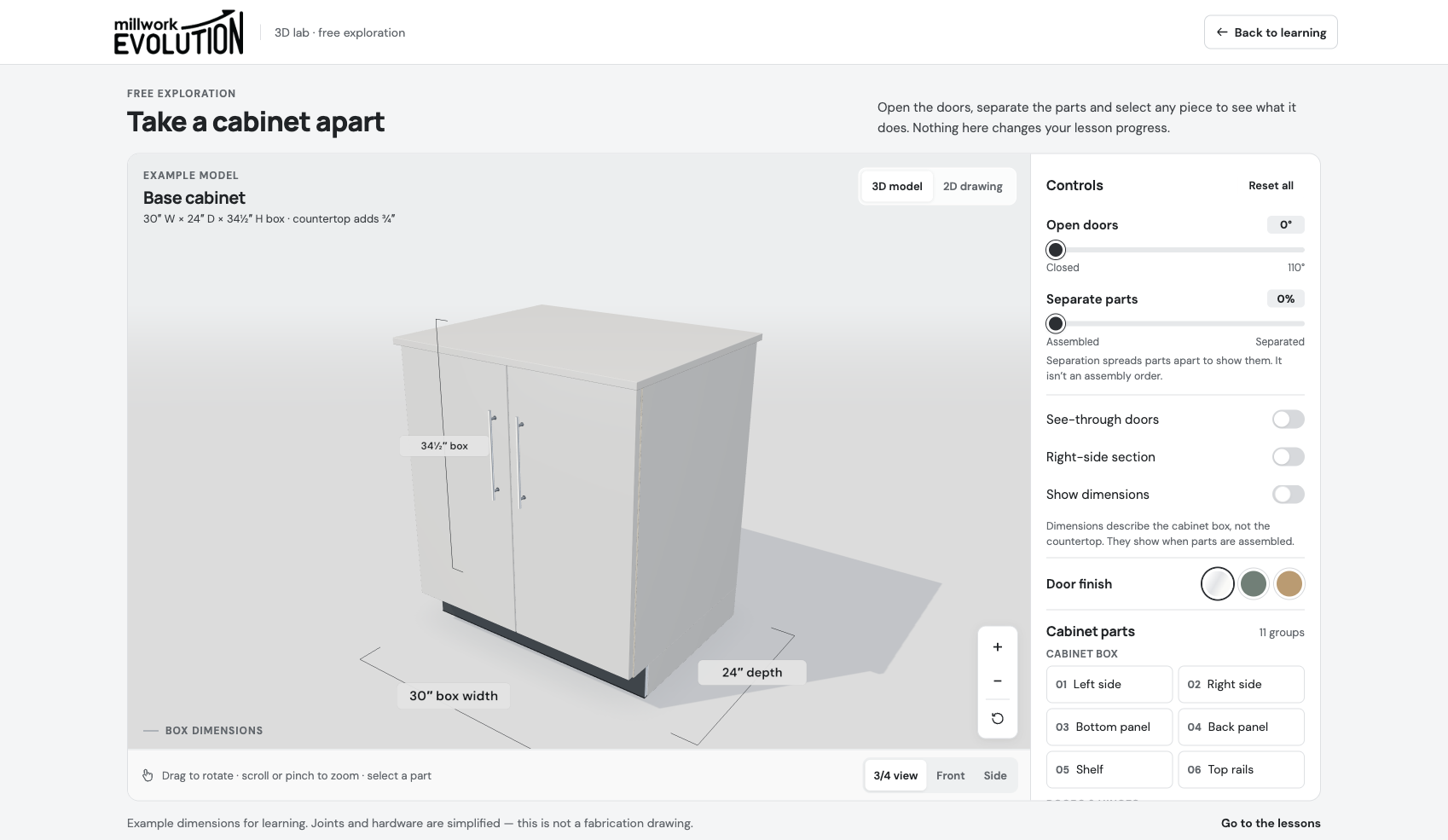
Millwork Evolution is a learning workspace for cabinetry and technical drawing. Guided sample lessons sit alongside a 3D base cabinet that learners can rotate, take apart, and inspect. The interface, lessons, questions, and part names are available in English and Spanish.
My work connects the Next.js and React course interface, the three.js lab, and learner progress. The public site is a sample course for evaluating the learning flow, rather than a completed training program.
The decision: keep the lab loaded between activities
A lesson can ask a learner to identify a panel, inspect a dimension, or change the model's view. Moving to the next activity should change the task without rebuilding the entire 3D scene.
The lesson player stays in the route layout while the activity URL changes. It communicates with the embedded lab through a versioned message contract. The receiving side checks the message shape, allowed controls, origin, and source window before applying a command or accepting a model event.
That gives the lesson and the model a defined boundary. A control change becomes an event the lesson can evaluate, rather than a separate copy of the model's state in the course UI.
The difficult case: returning from a stale device
Replacing a learner's entire progress document with the most recently written copy could erase completed lessons. A phone with an older copy can write after a laptop that has already finished more activities.
The progress merge works per lesson. Completed activities and satisfied task requirements are combined, and a completed lesson remains complete. Timestamps decide fields such as the last-opened lesson, rather than determining the whole learning record.
Supabase supports accounts and progress sync, while the lesson content and lab can run locally. The course is exported as a static site.
Scope and verification
The model uses example dimensions and simplified hardware. It is a learning aid, not a fabrication drawing. The repository includes tests for progress rules, message validation, answer parsing, and sync merging; those checks are separate from evaluating whether the lessons teach the material well.